Martha Ferguson was up before dawn, the way she often is, when she looked out her east-facing window and saw two columns of light blasting into the sky from a neighbor's property. Not stars. Not moonrise. Floodlights, aimed straight up, washing out the exact patch of sky she'd gotten up early to watch.
She has lived in Old Snowmass since 1984. The county lighting code followed years of testimony. This past February, Old Snowmass became Colorado's eighth certified International Dark Sky Community.
The Perseid meteor shower peaked the nights of August 11 through 13, and in 2026 the peak lined up with a new moon, which is about as good as meteor viewing conditions get. That gave residents their first real chance to see whether any of that actually worked. If the new lighting rules were doing what they're supposed to, that was the time you'd notice.
A Neighbor Dispute That Became County Law
The story of how Old Snowmass got here didn't start with a tourism board or a marketing plan. It started with Ferguson taking her frustration to the Snowmass Capitol Creek Caucus, the neighborhood nonprofit that's been organizing around land use and quality of life in the Snowmass Creek and Capitol Creek valleys since 1974.
Out of that came WildSky Old Snowmass, the advocacy group she founded specifically to push for smarter outdoor lighting. By 2024, that work had already taken her from caucus meetings to Pitkin County planning sessions to a public talk at The Arts Campus at Willits featuring the executive director of Arizona's Lowell Observatory, part of eighteen months of lobbying she'd put in by that point alone.
The issue she was addressing was practical. DarkSky International's own writeup on the certification points to a real estate detail underneath all of it: a wave of new construction that followed the pandemic brought with it a lot of exterior lighting.
"Two gigantic columns of light blasting through the night."
That's how Ferguson described the moment that started it in comments to the Aspen Times. At the time, the code had not caught up with outdoor-lighting concerns in a place where that kind of glow travels for miles.
What the Rewritten Code Actually Requires
Pitkin County hadn't touched its lighting code since 2006. The version that finally passed in 2025, the one that made the DarkSky certification possible, spells out specifics that any Old Snowmass property owner now has to work around:
- Most exterior lights must go off between 10 p.m. and 6 a.m., with exceptions for active businesses, street lighting, and parking areas
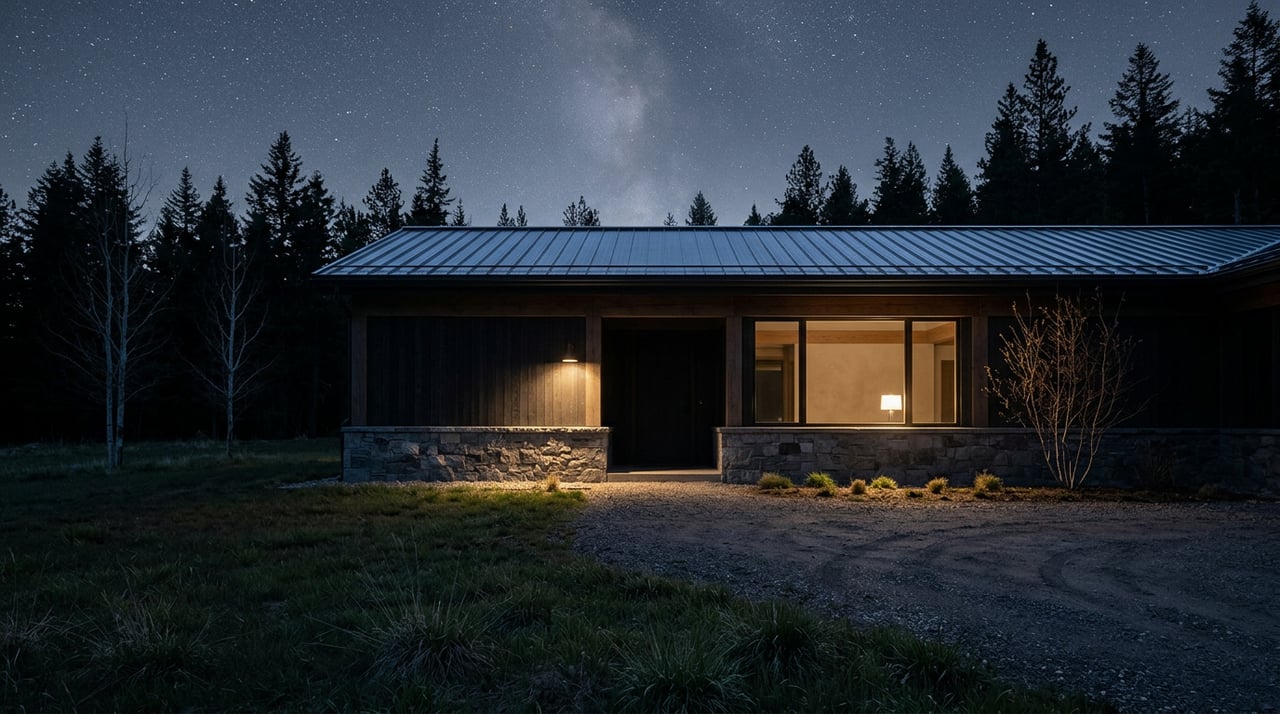
- Fixtures generally have to be shielded, directing light downward instead of outward or up
- Residential properties in higher-activity areas can keep up to two unshielded fixtures; properties in areas the county defines as ecologically sensitive can't have any
- Holiday lighting is restricted to a defined window, Nov. 15 through Jan. 30 for residential properties and Nov. 15 through March 1 for businesses
None of this bans outdoor lighting. Ferguson has said as much publicly, that the point was never "you can't have lights," it's being smart about the ones you have. But it does mean property owners in this stretch of the valley have new requirements for outdoor lighting.
The Dark Patch Between Two Glows
A 2024 Aspen Daily News piece on the valley's dark sky push included a nighttime aerial photo, taken roughly a decade before that, showing light spilling from Glenwood Springs on one end of the valley and Aspen on the other. Between them, Snowmass Canyon and Old Snowmass showed up as the dark gap. Not because anyone planned it that way. Large-lot ranch zoning, low density, and geography did most of the work long before anyone wrote a lighting ordinance.
What changed this year is that the darkness stopped being an accident of land use and became something the county actively protects. Old Snowmass sits along Highway 82 between Aspen and Basalt, at roughly 7,500 feet, a corridor of ranches and open meadow rather than a town center.
That geography is exactly what made the certification possible. DarkSky International's own writeup on the designation leans on that same framing: prehistoric roots, ranching heritage, open space that never got subdivided the way so much of the rest of the valley did.
The Perseids Offered a First Test
The certification became official in February. Since then, the Perseids have offered a marquee celestial event to check the results against. The Perseids are considered one of the more reliable annual meteor showers, and the 2026 new moon meant there was no moonlight washing out the fainter meteors the way there often is.
There's also a useful contrast just up the valley. On August 10, Aspen Snowmass and the Aspen Center for Environmental Studies held their annual Stars Above Aspen event atop Aspen Mountain, with a $32 ticket that included the gondola ride up.
It was a genuinely good event, with guided telescopes and a planetarium dome. But it exists because getting a dark enough sky in town requires elevation, infrastructure, and a lift ticket. In Old Snowmass, the same dark sky was supposed to be available by walking into your own yard, free, on the very nights the Perseids peaked.
A few practical notes for meteor watching:
- Give your eyes 20 to 30 minutes to adjust once you're outside, longer than most people expect
- Look toward the northeast after 9 or 10 p.m., where the constellation Perseus rises through the evening and climbs higher toward dawn
- Skip the flashlight, or switch your phone to night mode if you need one, since even brief bright light resets your night vision
- Turn off unshielded exterior lights while you're out there anyway, both because it helps your own viewing and because it's now what the code asks of you between 10 p.m. and 6 a.m.
- Don't expect a show every minute. Perseids come in bursts, and patience matters more than staring at any one patch of sky
A Milestone, Not a Finish Line
Michael Rymer, the DarkSky International program manager who also worked with Old Snowmass through its certification, told the Post Independent that the point applies everywhere a community earns this status: "Certification is not the finish line, it's just a milestone."
Places that earn the designation have to keep doing outreach and monitoring sky quality to hold onto it. WildSky Old Snowmass isn't disbanding now that the plaque is earned. Ferguson has said most people who were out of compliance with the new rules got there by accident, not defiance, which means the education work continues as more people move into the valley and build.
That's really the throughline here. Old Snowmass didn't get this designation because someone decided dark skies would be good marketing. One resident's early morning frustration helped bring the issue into focus, followed by years of unglamorous committee work, a county code that took nineteen years to rewrite, and a community willing to change how they light their own front porches for something they couldn't see any other way.
The Perseids offered the first opportunity since the plaque went up to see whether that work was having an effect. For future meteor showers, step outside after dark, give your eyes time, and look northeast.
If you're the kind of person who ends up thinking about what makes a specific piece of this valley worth calling home, whether that's the dark sky, the ranch acreage, or something else entirely, that's a conversation Jessica Hughes has with Old Snowmass neighbors all the time. No pressure to make it about real estate. If it ever does become that conversation, she's glad to schedule a confidential consultation whenever you're ready.
This article is general information, not legal, tax or financial advice. Consult a qualified professional about your situation.